Salbo.ai
Salbo.ai
Artificial Intelligence and
Real World Knowledge
Artificial Intelligence and
Real World Knowledge
Founded by Kristin Eklöf

Kristin founded salbo.ai in 2020. She holds a PhD in Data Science. Before salbo.ai, she was lead data scientist on the award-winning Track Decision Support Tool, a predictive maintenance product for Network Rail at SNC-Lavalin Atkins. She has also worked as a statistician at Trafikverket and as a scientist at TRL in the UK and as a data science consultant for the manufacturing industry. Recent work with Mistra InfraMaint and Nacka municipality.
I dwell in possibility. — Emily Dickinson
Our Services

Predictive maintenance
Models that forecast condition and service life for roads, railways and production equipment, so assets are maintained at the right time and cost.

Life-cycle and climate assessment
Emissions and life-cycle cost of materials, products and maintenance, with a systems view that shows whether an improvement holds across the whole value chain.

AI for industry
Machine learning and AI agents that turn manufacturing and infrastructure data into clear decisions, built for complex, interconnected systems.
showcase
PARTNER WITH US
We are building consortia for European and Nordic research and innovation calls. If your organisation works with infrastructure, manufacturing, data or sustainability, we would like to hear from you.

SamGräv – coordinating road and utility works
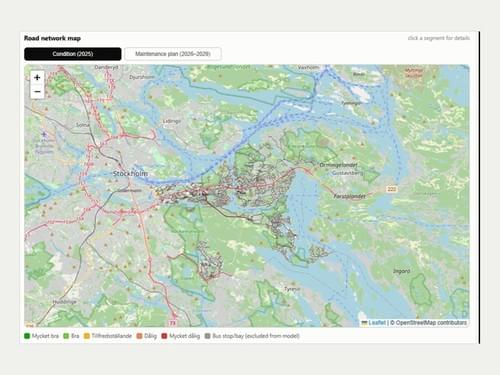
When road resurfacing and underground utility works are planned separately, newly paved streets are often dug up again a few years later: double cost, double emissions, double disruption. SamGräv is a concept for AI-supported planning that matches road maintenance plans with planned water, energy and telecom works, and proposes a coordinated schedule before anyone starts digging. It builds on Vägar för framtiden. We are looking for municipalities, utility companies, data providers and research partners to develop and test it, in Sweden and internationally.

COMPASS – complex adaptive systems for sustainability
Most sustainability tools assess one metric at a time. COMPASS is a framework in development that makes system-level effects visible at the moment of decision: rebound effects, lock-in and long-term trade-offs, screened alongside life cycle assessment and carbon accounting. We are forming a consortium for the SMART Eureka Cluster call and are looking for manufacturing companies, technology providers, public infrastructure owners and research institutes.
Concept and framework developed by Angelica Valentinson.
Publications
Our methods are peer-reviewed and published. Selected work:

Svenson, K., Li, Y., Machucova, Z., and Rönnegård, L., Transportation Research Record: Journal of the Transportation Research Board, 2016, Vol.2589, 51-58.
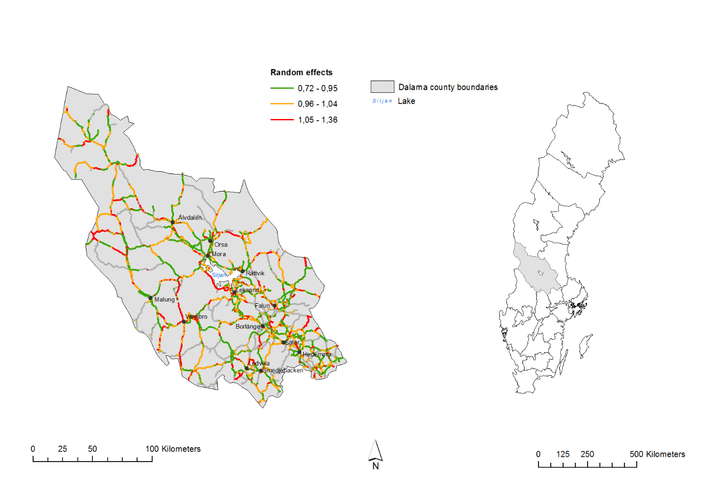
Road databases often lack key information such as subsoil conditions, the underlying construction or the true amount of heavy traffic. This study uses a mixed proportional hazards model to capture the effect of these hidden factors on each road section's risk of needing maintenance. It pinpoints the weakest and strongest sections in a network, which helps target long-term maintenance plans and budgets.

Svenson, K., McRobbie, S., and Alam, M., , International Journal of Pavement Engineering, 2019, Vol 20, No. 4, 458-465.
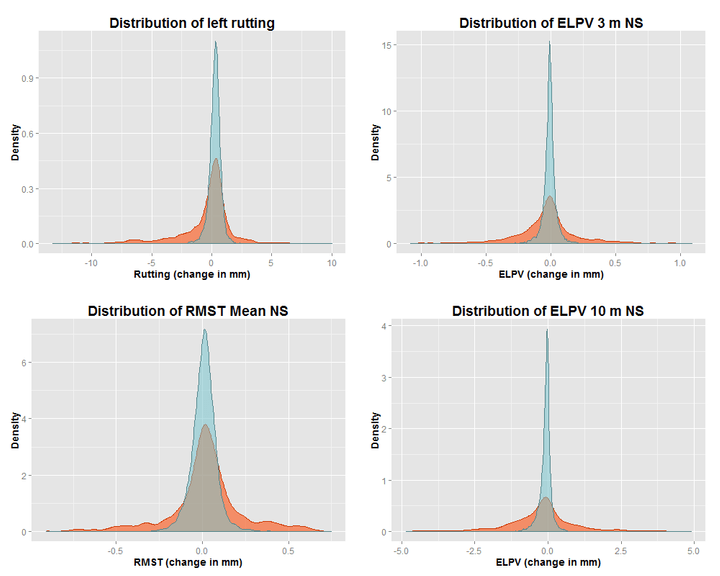
When budgets are tight and two roads look equally worn, the one deteriorating fastest should be treated first. Using condition data from part of England's M4 motorway, this study uses finite mixture models to classify road segments as changing or stable. Checked against maintenance records, the method picks out the fastest-deteriorating segments and supports more efficient maintenance decisions.

Svenson, K., Journal of Transportation Engineering, 2014, Vol. 140, No. 11, 04014056.
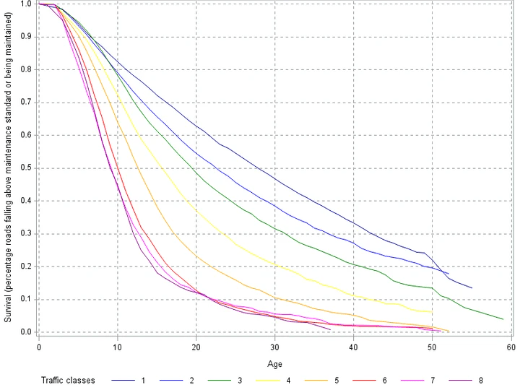
Reliable lifetime estimates are the foundation of life-cycle cost analysis for roads. Combining maintenance records and condition measurements, this study estimates how long Swedish pavements last and what shortens or extends their life. Stone mastic asphalt had a 36% lower risk of needing maintenance than asphalt concrete. Higher speed limits shortened lifetimes, while wider roads and larger stone sizes lengthened them.

Nilsson, J-E., Svenson, K., and Haraldsson, M., Transportation Research Part A: Policy and Practice, 2021, Vol 139, 455-471.
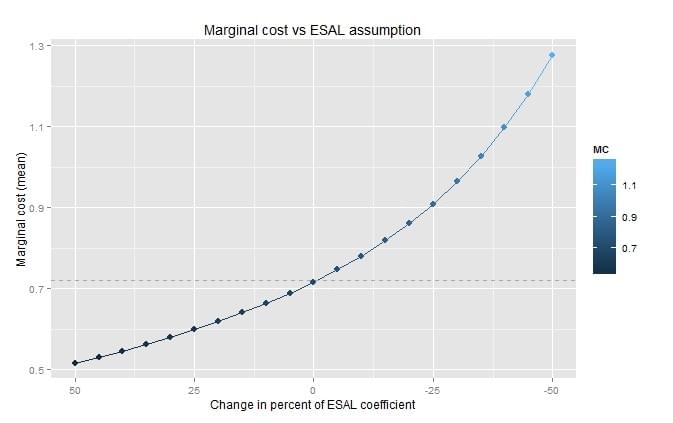
What does each vehicle cost the road it drives on? Using detailed data on road sections, pavement age, pavement type and traffic, this study estimates the marginal cost of road wear across the Swedish network and finds large differences between roads. Heavy vehicles aren't the only cause: passenger cars contribute too, likely through studded tyres in a freeze-thaw climate. That matters for fair road-use pricing.

Eklöf, K., and Wendel, M., Transportation Research Record: Journal of the Transportation Research Board, 2023, Vol 2679, Vol 4.
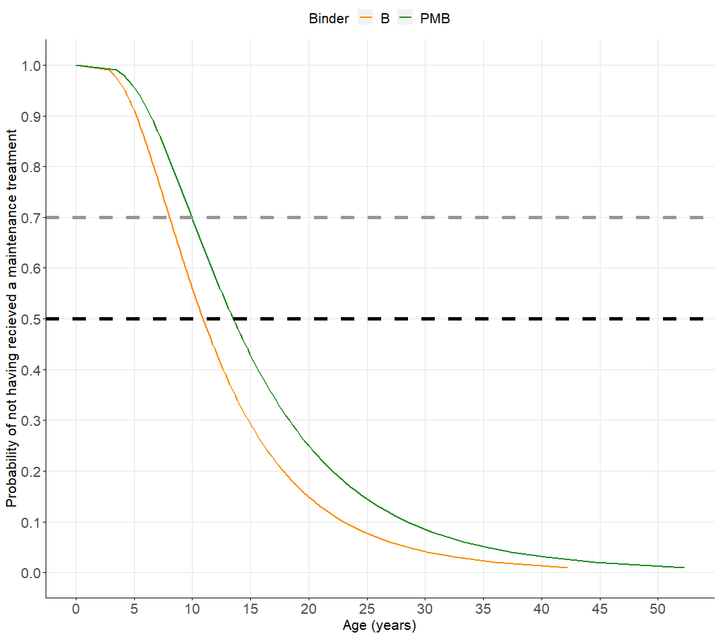
Do premium binders actually make roads last longer? Using almost 500,000 maintenance and condition records from the Swedish Transport Administration, dating back to the 1970s, this study compares polymer-modified bitumen with conventional bitumen on otherwise similar roads. Polymer-modified bitumen extended expected road life by 15% in the surface layer, 8% in the underlying layer and 24% in both. That gives buyers hard evidence for choosing materials by durability.

Eklöf, K., Nwichi-Holdsworth A., and Eklöf, J., Transportation Research Record: Journal of the Transportation Research Board, 2021, Vol 2675, Vol 12.
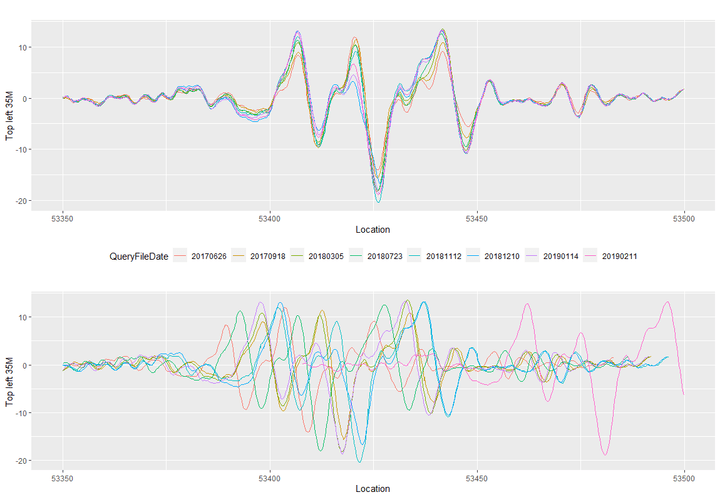
Predictive railway maintenance depends on comparing repeated measurement runs of the same track, but those runs rarely line up exactly. This paper presents a new algorithm that aligns them precisely, solving long-standing problems such as segmented data, varying sample rates and measurement errors. It was tested on track geometry data from the British rail network, owned and operated by Network Rail.

Assessing Sweden's Greenhouse Gas Emissions from Road Maintenance using Environmental Product Declarations and Network Life-Cycle Optimization
Eklöf, K., Ekblad, J., Rashedi, R., and Löwhagen, L., Transportation Research Record, 2026.
How much has Sweden cut the climate impact of keeping its roads in good shape? This study combines asphalt environmental product declarations (EPDs), pavement lifetimes from over 400,000 maintenance records and network optimization across Stockholm, Skåne and Norrbotten. Emissions have fallen 28–30% since 2010, mainly through biofuel-heated asphalt plants and more recycled asphalt. Adding a 5% bio-based binder could take the cut to about 60%, as long as the roads last as long.

Doctoral dissertation, Dalarna University, 2017.
Turns detailed records of road and rail condition and maintenance into decision support for infrastructure owners. Across five studies, it estimates how long Swedish pavements last, finds sections that wear out faster than expected and prices the road wear caused by heavy and light vehicles. It also separates deteriorating road segments from stable ones and measures how speed restrictions affect railway running times.
LET'S CHAT!

Kristin on LinkedIn

Based in Sala, Sweden